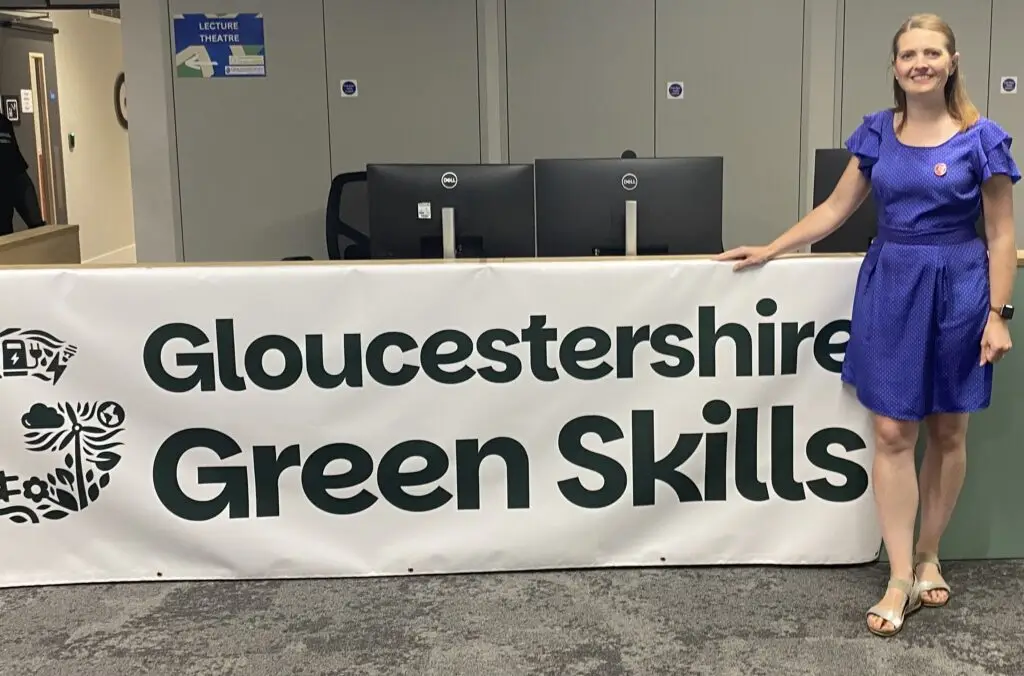
Business leaders, educators and public sector organisations came together at the Gloucestershire Green Skills Conference on 8 July to explore how the county can develop the skills needed to support the transition to a greener economy.
A clear message emerged throughout the day: Gloucestershire has a significant opportunity to become a leading hub for sustainable business and green innovation, but success will depend on collaboration across education, industry and local government.
Opening the conference, Cllr Linda Cohen called for an “entrepreneurial and collaborative approach” to developing the green skills the county needs.
The University of Gloucestershire showcased its commitment to sustainability through the retrofit of its new City Campus, transforming the former Debenhams building into a modern education facility. The project retained 95% of the original structure, saving an estimated 40% in embodied carbon.
Dr Katherina Kantartzis from the University of Gloucestershire highlighted the importance of enabling sustainable choices, saying: “Sustainability is not what we build but the choices we enable.”
The conference also explored the scale of the economic opportunity presented by the green transition. Dr Tanya Lawes from Skills England outlined the UK’s Clean Energy Jobs Plan and highlighted forecasts that clean energy jobs could increase from 420,000 to 860,000 by 2030.
Speakers identified a wide range of future skills needs, from renewable energy and sustainable construction to manufacturing, engineering and retrofit. They also stressed the importance of strengthening careers advice and introducing sustainability education earlier, beginning in primary schools and continuing throughout further and higher education.
Professor Matt Reed from the University of Gloucestershire’s Centre for Research in the Countryside and Community (CCRI) spoke about the need for greater public engagement and dialogue around climate action, noting that most people want progress to happen quickly and that understanding barriers to change will be key to accelerating action.
The conference also highlighted the strength of Gloucestershire’s education sector, with universities, colleges and training providers collectively supporting more than 42,000 students and employing over 16,000 staff. However, challenges remain, including funding for reskilling existing workers and ensuring businesses can access the expertise needed to navigate the transition.
For Gloucestershire’s business community, the message was clear: the green economy is not a future aspiration—it is already creating opportunities today. Businesses that invest in sustainability, develop new skills and collaborate with others will be well placed to benefit from the transition.
Inspired by the momentum generated at the conference, sustainability leaders Fran Page and I are launching the Gloucestershire Responsible Business Accelerator, an eight-week cohort programme designed to help businesses take their first meaningful steps on their sustainability journey. The programme will enable participants to learn alongside like-minded peers while developing a practical, personalised sustainability roadmap for the future.
As Gloucestershire continues to position itself as a county that is good for both people and the planet, the conference demonstrated that the foundations are already being laid. The challenge now is turning ambition into action and ensuring businesses of all sizes have the support and skills they need to be part of the transition.
Register your interest today or get in touch with camilla@betterbusinessbetterworld.org to find out more. https://www.tickettailor.com/events/betterbusinessbetterworld/2287751